 Switzerland
What Aikijutsu is
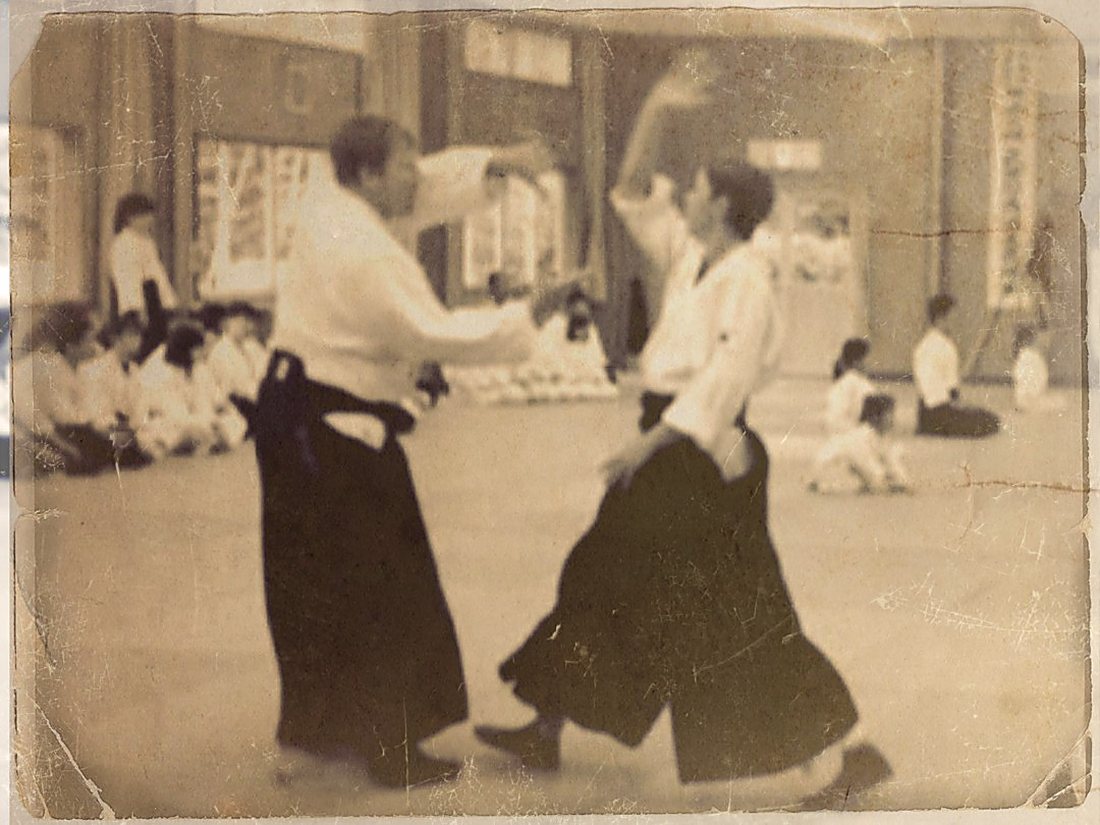
Aiki-jūjutsu, often written simply as Aikijutsu, is not a martial art of its own alongside Jūjutsu but a particular way of carrying it out. The difference lies in where it takes hold.
Ordinary Jūjutsu works at the joint and the lever: the arm is turned, the balance taken, the opponent falls. Aiki starts a stage earlier — at posture, balance and intent. Once the opponent's structure is disturbed, the technique itself needs almost no force. Anyone seeing it for the first time takes it for collusion; anyone who feels it understands why it takes years.
Origin
Daitō-ryū traces its transmission back to the Takeda family of the Aizu clan, with a line of ancestors reaching to Minamoto no Yoshimitsu in the 11th century. It becomes historically tangible with Takeda Sōkaku (1859–1943), who began to teach the school publicly from 1898 and trained several thousand students in seminars across Japan — among them police officers, army officers and landowners.
Aikijutsu and Aikidō
One of Takeda's students was Ueshiba Morihei. From this foundation he developed Aikidō.
The two are therefore related, but not the same:
| Daitō-ryū Aiki-jūjutsu | Aikidō | |
|---|---|---|
| Purpose | control and neutralisation | harmony and resolution of conflict |
| Atemi | central, often the technique itself | indicated |
| Curriculum | fixed series, Ikkajō to Gokajō | freer, depending on the style |
| Transmission | Koryū line with certificates | modern federation structure |
Anyone who knows Aikidō and wants to know where it comes from will find the answer in Daitō-ryū.
The curriculum
Extensive and ordered in series: Ikkajō to Gokajō form the framework with more than a hundred techniques, followed by Aiki no jutsu, Hiden Mokuroku and further levels. Practice takes place seated (suwari-waza), in the half-standing position (hanza handachi) and standing.
After Takeda Sōkaku's death the school branched into several organisations — Daitōkan under Kondō Katsuyuki, Takumakai, Roppōkai, Kōdōkai and others — each setting its own emphases. Anyone looking for a Dōjō should ask which line it belongs to.
Aikijutsu in Switzerland
Daitō-ryū is thinly represented in Switzerland — there is no dense network as there is for Aikidō or Jūdō. Two routes lead further:
- Motoha Yōshin-ryū in Cham ZG and Boswil AG — a Koryū of the Takagi family. Not Daitō-ryū, but the closest available way to train classical Japanese Jūjutsu with joint locks, throws and short weapons in a documented line.
- Bushu News — the Swiss portal for combat sports and martial arts. Seminars and groups not yet listed here are announced there.
If you run or know of another Daitō-ryū group in Switzerland: please get in touch — the entry will go on this page.
What to look out for
"Aikijutsu" is not a protected term. There are schools that invoke it without belonging to one of the transmitted lines. That need not be a bad thing, but it is something other than a Koryū with traceable transmission. The one question that brings clarity: which line does the Dōjō belong to, and who graded the teacher?