 Switzerland
Origin
Iizasa Chōisai Ienao was a warrior in the service of the Chiba family in the province of Shimōsa. After the fall of his house he withdrew into the precinct of the Katori-Jingū, one of the oldest shrines in Japan, and spent a thousand days and nights there in austerity and weapons practice. At the end of that time, so the tradition goes, he received the teaching of the Ryūha as divine inspiration — hence the name: Tenshin Shōden, "truly transmitted from heaven".
That was around 1447. The school has been handed on without interruption in the Iizasa family ever since and is today a Japanese intangible cultural property (Mukei Bunkazai). It is regarded as a source school — numerous further Ryūha have emerged from it over the centuries.
What is trained
Katori Shintō-ryū is a sōgō bujutsu, a complete system. The curriculum covers:
- Kenjutsu — the long sword, core and measure of the system
- Iaijutsu — drawing and cutting out of movement
- Bōjutsu — the long staff
- Naginatajutsu — the halberd
- Sōjutsu — the spear
- Ryōtōjutsu — fighting with two swords
- Shurikenjutsu — the throwing blade
To these are added the classical secondary subjects of a warrior of the Sengoku period: Chikujō-jutsu (field fortification), Gunbai-hō (troop command) and In-yō kyō, the study of tides and omens.
Training is exclusively in Kata with a partner, without armour, with full intent and controlled distance. There is neither competition nor free sparring — the test lies in the precision of the form. Public demonstrations are called Embu and serve remembrance, not comparison.
The Sugino line
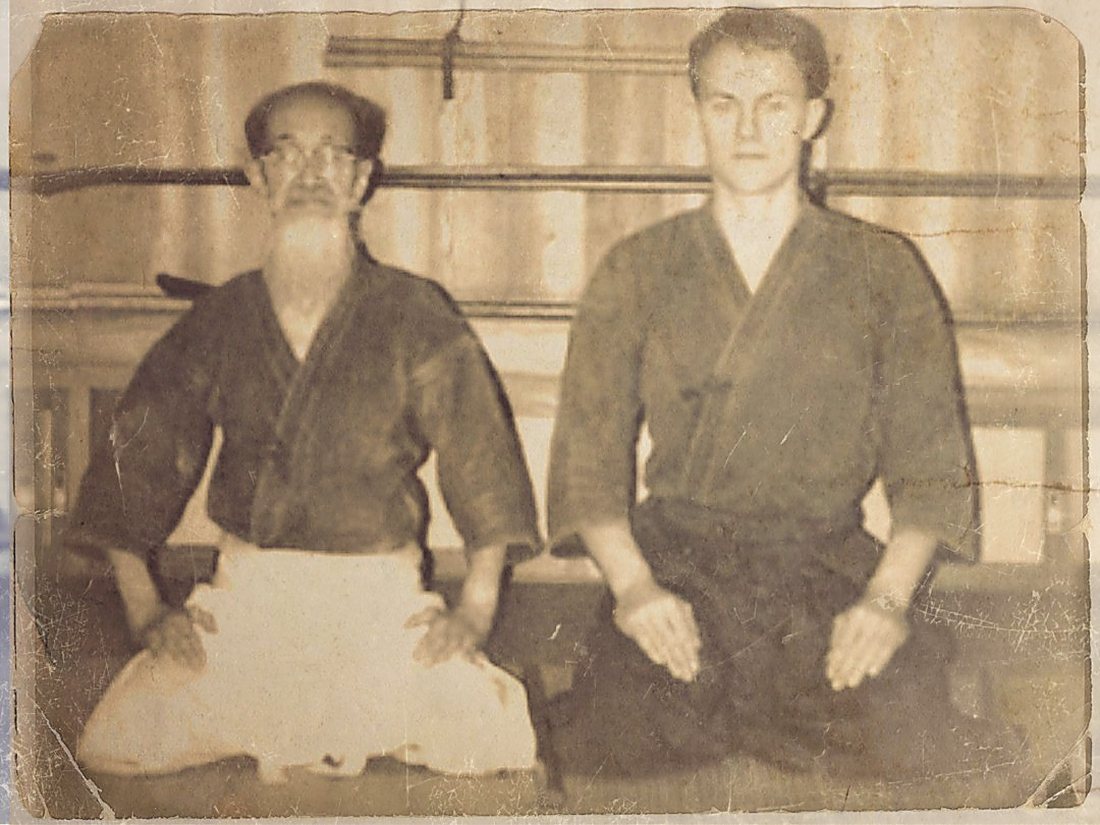
The Swiss Dōjō belong to the line of Sugino Yoshio (1904–1998). Sugino Sensei received his Menkyo Kaiden in 1935 from Iizasa Yasusada and opened a Dōjō in Kawasaki that made the Ryūha known far beyond Japan in the 20th century. Among others he taught Ueshiba Morihei, and he advised Akira Kurosawa on the sword scenes of Seven Samurai.
The Sugino Dōjō in Kawasaki is led today by Sugino Yukihiro and is the Honbu of the line to which the Swiss groups are affiliated through SHIBU Suisse.
In Switzerland
Katori Shintō-ryū is by some distance the most widely represented Koryū in Switzerland — from Basel and Romanshorn through Lucerne and Biel to Neuchâtel, Lausanne, Geneva and the Valais. Many of the Dōjō are also Aikibudō or Karate clubs in which Kobudō runs as a programme of its own.
Where training takes place
The Swiss Dōjō are organised through SHIBU Suisse KSR, the official delegation of the Sugino line. All of them are under the technical supervision of Sugino Yukihiro and Loris Petris.
SHIBU Suisse keeps its own directory up to date — which is why koryu.ch points to it instead of maintaining the same details a second time.